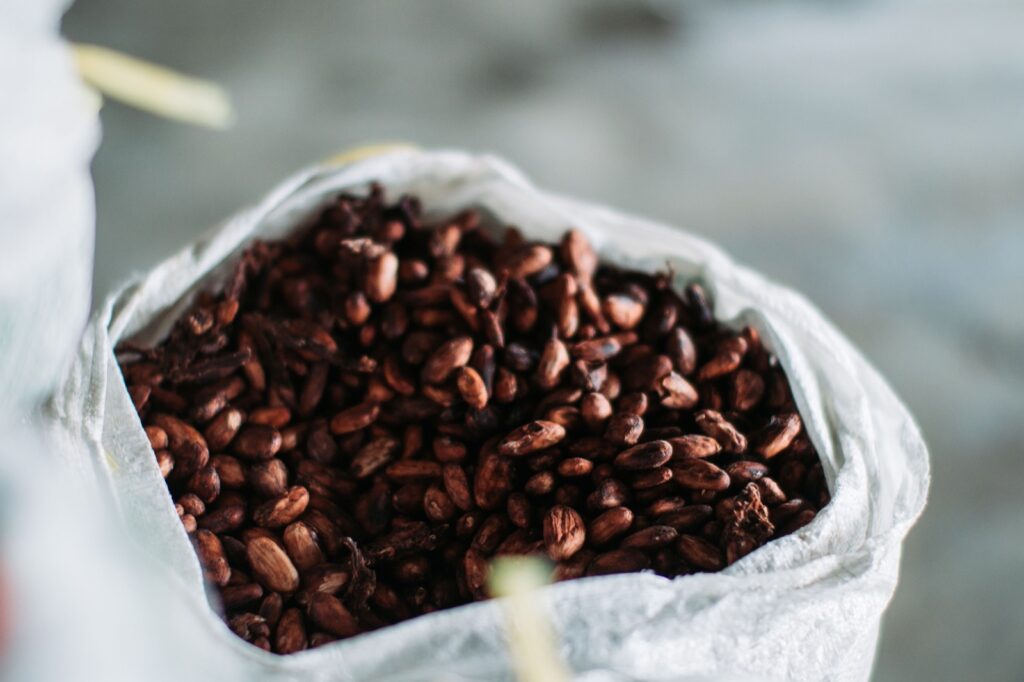
Two regions dominate the world’s cocoa conversation for opposite reasons. West Africa — Ivory Coast and Ghana — supplies over 70% of global bulk volume. Ecuador leads the fine flavor segment. For a chocolate maker deciding where to source, this is not a marginal choice: it defines your product’s flavor ceiling, your supply risk, and increasingly your regulatory exposure.
Different genetics, different destinies
West African production is built on Forastero varieties: hardy, productive, and standardized. The result is dependable chocolate flavor at scale — the base of every mass-market bar. Ecuador’s identity rests on Cacao Nacional and Trinitario lineages, whose beans carry the floral, fruity aromatics that define fine flavor. One origin optimizes for volume; the other for character.
Flavor: standardized vs. distinctive
West African cocoa is deliberately uniform — blended across thousands of farms into a consistent, anonymous stream. Ecuadorian fine flavor cocoa is the opposite: origin-distinct, traceable to region and even farm, with sensory profiles a trained panel can identify blind. Premium chocolate is built on that distinction, which is why bean-to-bar makers list origin on the front of the wrapper.
The price equation
Bulk West African cocoa trades around $3,100 per metric ton in current markets, and fine flavor lots command a premium above bulk that varies with grade, fermentation index and certification. But the more revealing number is what reaches the farmer: an Ecuadorian producer receives roughly 90% of the world price, versus 60–70% in West Africa’s regulated systems. That margin funds better post-harvest work — fermentation and drying are where fine flavor is won or lost — and keeps quality improving.
Disease and climate: the supply risk nobody can ignore
West Africa is fighting a two-front battle: black pod disease and swollen shoot virus have devastated orchards in Ghana and Ivory Coast, while erratic rainfall compounds losses. These pressures drove the historic price spikes of recent years and continue to constrain recovery. Ecuador is not immune to plant disease, but its pathogen pressure is structurally lower and its orchards younger and better renovated. The result: Ecuador’s output is growing around 11.3% in volume while West African production contracts.
An honest caveat: El Niño
Ecuador’s own climate risk deserves naming: El Niño cycles bring heavy coastal rains that can disrupt harvests and logistics. Buyers should treat this as a planning variable — diversified regional sourcing within Ecuador and forward programs mitigate it — not as a reason to avoid the origin. Every origin carries weather risk; Ecuador’s is at least well-mapped and cyclical.
Traceability: the new dividing line
The EU Deforestation Regulation has turned supply chain transparency into a purchasing requirement. Here the gap widens further: Ecuador’s smallholder agroforestry systems and established farm registries make plot-level traceability achievable today, while fragmented West African chains face a harder road. For EU buyers, that difference is already reshaping supplier lists.
The bottom line
If you need maximum volume at minimum cost, West Africa remains the default. If your product depends on flavor, story, farmer equity and regulatory readiness, Ecuador is the strongest origin on the board — and it is gaining share for exactly those reasons.
Ready to compare for yourself? Source fine flavor cacao from Ecuador through KATUNA Trade — samples, specifications and full export documentation from verified origin.