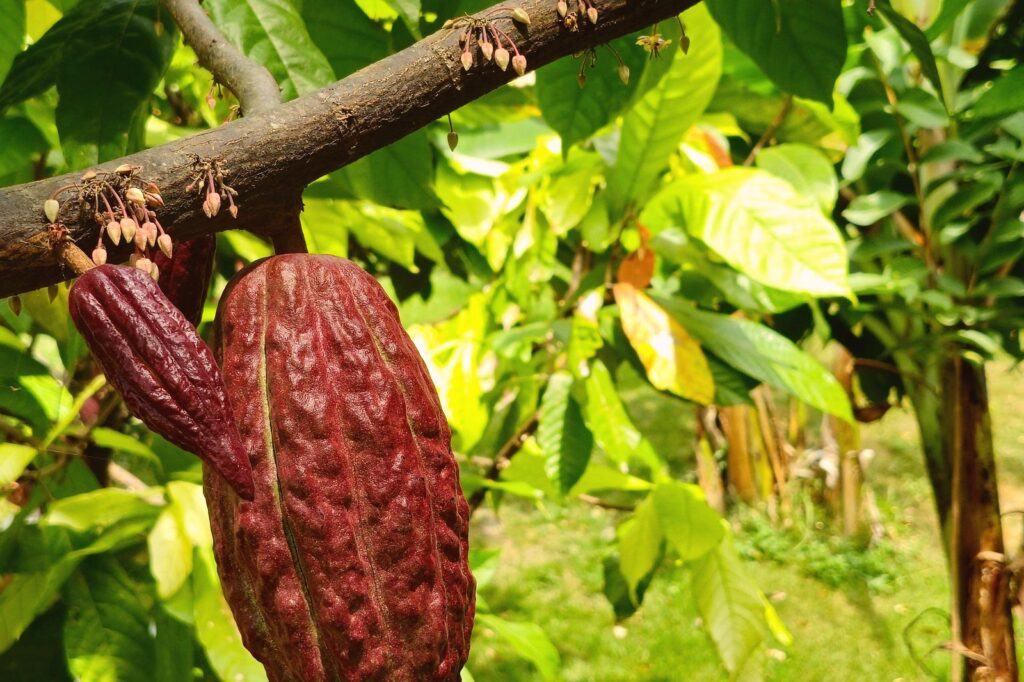
Ecuador supplies more than half the world’s fine flavor cacao. That single fact is why “ecuador cocoa beans” has become one of the fastest-growing search terms among chocolate makers and confectionery buyers in Europe and North America. But knowing where fine flavor cacao comes from is different from knowing how to actually buy it — reliably, at the grade you need, without losing three months to a supplier who can’t produce documentation when your customs broker asks for it.
This guide walks through what buying Ecuador cocoa beans direct from origin actually involves.
What “direct from origin” really means
Most cocoa beans that reach European and North American manufacturers pass through at least one trading house before they arrive. That’s not inherently bad — large trading houses offer scale and consistency. But it also means markup, longer chains of custody, and less visibility into which farm, or even which region, your beans actually came from.
Buying direct from origin means working with an exporter that sources, verifies and consolidates beans from producers in Ecuador itself, rather than reselling beans someone else already exported. The tradeoff is that you need a partner who can handle what a trading house normally absorbs: farm verification, pre-shipment quality control, certification management, and export documentation.
Step 1: Know which variety you’re buying
Ecuador grows two commercially distinct types of cacao, and they are not interchangeable:
- Nacional (Arriba) — the heirloom, fine-flavor variety. Floral and fruit-forward, the profile fine chocolate makers specifically seek out.
- CCN-51 — a high-yield hybrid. Chocolate-forward and consistent, prioritizing volume and fermentation reliability over cupping complexity.
If your buying decision depends on which one fits your product, we’ve written a full comparison: Nacional Cacao vs. CCN-51: What Buyers Need to Know Before Choosing a Supplier.
Step 2: Understand the grading system you’ll actually see on paperwork
Ecuador’s official cacao grading standard is NTE INEN 176, administered with ANECACAO. Every legitimate export lot should be gradable against it. The standard sets, by grade, maximum moisture (7% across all grades), minimum share of well-fermented beans, and maximum allowance for defective or slaty (unfermented) beans. Ask any supplier quoting you a lot which grade applies — if they can’t answer specifically, that’s a signal to ask more questions, not fewer.
Step 3: Certifications to ask for before you commit
At minimum, a serious exporter should be able to produce:
- AGROCALIDAD phytosanitary certification (Ecuador’s agricultural health authority)
- EUDR-ready traceability — farm-level geolocation and chain-of-custody documentation, now effectively required for EU-bound shipments under the EU Deforestation Regulation
- Organic or Fair Trade certification, if your product line requires it — available on request, not always standard
Step 4: Understand the logistics before you quote a price internally
A standard export sack for Ecuadorian cacao runs 60–65 kg of jute-packed beans. A 20′ container typically carries 200–210 sacks — roughly 13–14 metric tons. Most exporters, KATUNA included, consolidate volume across multiple verified producers to reach that container minimum, which means your order may represent several farms rather than one — ask how that consolidation is verified and documented if single-origin traceability matters to your buyer story.
Standard terms are usually quoted FOB from Guayaquil port, with CFR and CIF available on request.
Step 5: Sample before you commit to volume
No exporter worth working with should ask you to place a full container order sight-unseen. Commercial samples should be available for evaluation before you confirm a purchase order — this is standard practice, and any resistance to it is worth treating as a red flag.
Working with KATUNA Trade
KATUNA Trade sources Nacional (Arriba) and CCN-51 cacao directly from verified producers across Ecuador’s coastal, Andean-foothill, Amazon and contracted Galápagos growing regions. We manage AGROCALIDAD certification, EUDR-ready traceability, pre-shipment quality control and sample logistics as part of the sourcing process — not as a separate add-on.
If you’re evaluating Ecuador as a cacao origin, request samples and we’ll walk you through grades, pricing and lead times for the volume you need.