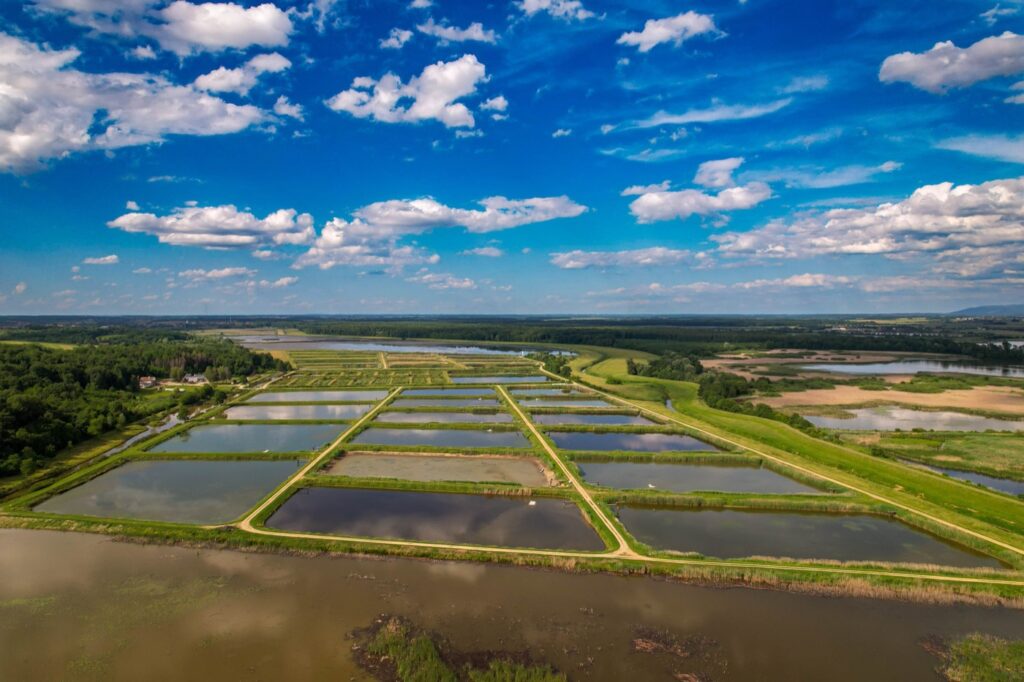
Ask a shrimp buyer why Ecuadorian product commands a reputation for consistency, and most won’t mention pond design. They’ll talk about taste, size, or price. But the pond model underneath all of that — extensive farming, at low stocking density, on large ponds — is arguably the single biggest structural reason Ecuador’s shrimp industry looks the way it does.
The core difference: how many shrimp per square meter
Shrimp farming intensity is defined mostly by stocking density — how many post-larvae go into a given area of water — along with water exchange rates, aeration, and reliance on artificial feed versus natural pond productivity.
Ecuador farms at roughly 8 to 25 post-larvae per square meter. Compare that to the intensive models common in parts of Asia: India runs around 30–40 PL/m², and advanced intensive systems in Vietnam push as high as 220–260 PL/m² in smaller tanks — in some cases reaching 500 PL/m² at the extreme end. That’s not a small gap. Ecuador’s ponds are, on a per-shrimp basis, farming at a fraction of the density used elsewhere.
What lower density actually buys you
It isn’t just “more space, happier shrimp” as a slogan — it’s a specific, measurable trade-off with real consequences:
- Lower stress, fewer disease outbreaks. Shrimp crowded at high density are more vulnerable to pathogens like white spot syndrome virus and other diseases that spread faster in dense, high-exchange systems. Ecuador’s larger ponds are deliberately designed to mimic natural estuarine conditions — often with mangroves growing close by — which reduces the stress load that makes disease outbreaks more likely in the first place.
- Higher survival rates. Industry reporting puts Ecuadorian survival rates in the 60–70% range under this model, a meaningfully more stable outcome than the higher-failure-rate dynamics that intensive Asian systems have struggled with, particularly around pathogens like EHP and AHPND.
- Less reliance on chemical intervention. Lower density, lower stress systems generally need less antibiotic and chemical input to manage disease pressure — which lines up directly with the industry’s broader move toward probiotic pond management.
The trade-off buyers should know about
This isn’t a story where Ecuador simply “does it better” with no downside. Intensive systems in Asia produce dramatically more shrimp per hectare — advanced Vietnamese systems report yields around 150 tonnes/ha/year, compared to roughly 1,200 kg/ha/year in Ecuador’s extensive model. Ecuador trades yield density for stability: fewer catastrophic losses, more predictable harvests, and a lower-risk profile — but it also means Ecuador’s growth in export volume comes primarily from expanding pond area and improving genetics, not from packing more shrimp into the same water.
Why this matters for sourcing decisions
If your buying criteria include disease-outbreak risk, antibiotic-use profile, or supply consistency, the farming model isn’t a footnote — it’s close to the whole story. A supplier working with Ecuadorian Litopenaeus vannamei stock is, by the nature of the country’s dominant farming model, already starting from a lower-density, lower-stress production baseline than a supplier sourcing from high-intensity Asian systems. That’s not a marketing claim; it’s a structural feature of how the ponds are built and run.
Sourcing through KATUNA Trade
KATUNA sources from producers across Ecuador’s five shrimp-farming provinces, working within this extensive/semi-extensive model as the baseline, not the exception. If disease-risk profile or antibiotic-use documentation matters for your import requirements, ask us directly — it’s the kind of question Ecuador’s farming model is well positioned to answer.
See KATUNA’s full sustainability practice, including mangrove restoration and probiotic pond management, on the shrimp product page →