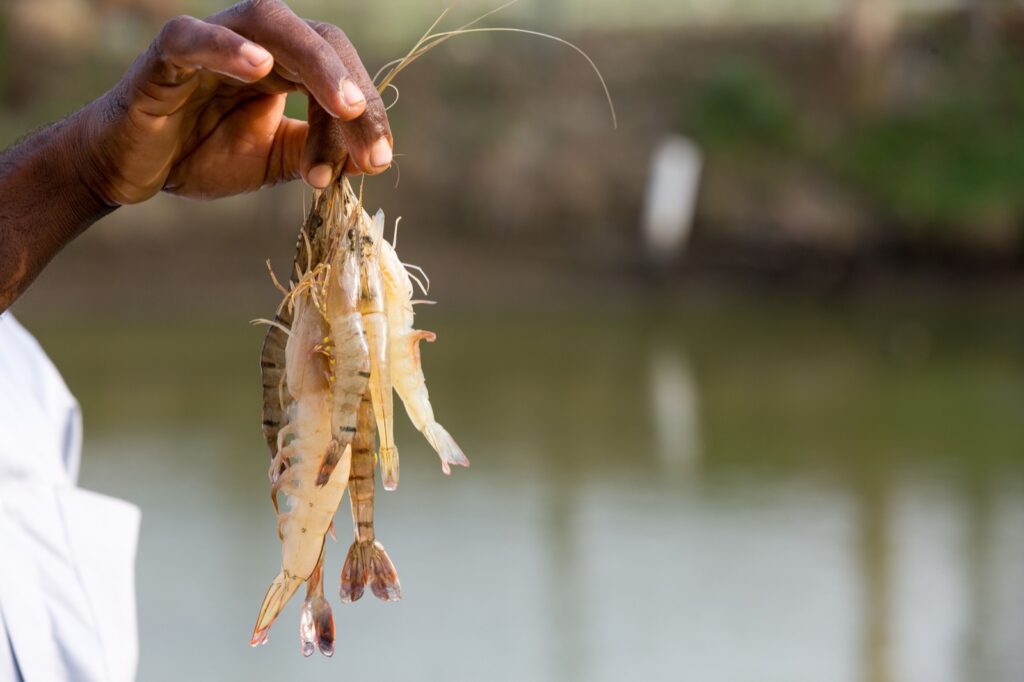
On June 30, 2026, China’s General Administration of Customs (GACC) suspended seven Ecuadorian shrimp processing plants over sodium metabisulfite residue findings — bringing the total to 14 plants suspended since October 2025. Affected companies include some of the industry’s largest names: Santa Priscila, Songa, Nirsa/Proposorja, Omarsa and OceanTreasure. Here is what actually happened, what the compound is, and what it means if you buy Ecuadorian shrimp.
What changed: the testing methodology
The central fact of this dispute is technical. China changed its testing methodology: laboratories now analyze shells and heads, not just the edible meat. Sulfite treatment is applied externally at harvest, so shells naturally retain higher residue than the flesh people eat. Measuring them inflates detected levels without any change in the product itself — or in what a consumer would ever ingest.
The consequences accumulated fast: in May and June 2026, 132 lots were rejected, roughly 2,904 metric tons of product. The economic impact so far in 2026 is estimated at $45 million.
Why the stakes are so high
China is not a marginal market for Ecuador — it represents 51.24% of Ecuador’s shrimp export value, some $1.22 billion between January and April 2026. Ecuador’s Ministerio de Agricultura has until July 16, 2026 to submit its technical response to GACC, and a bilateral technical working group is operating under the two countries’ free trade agreement framework.
Ecuador’s core argument: its shrimp meets the European Union standard (150 ppm in edible meat) and the US FDA standard (100 ppm) — the internationally accepted benchmarks, measured where they matter: in the part people eat.
What sodium metabisulfite actually is
Sodium metabisulfite (Na₂S₂O₅, food additive code E223) is a globally approved preservative and antioxidant. In shrimp processing it is used universally — by every producing country — to prevent melanosis, the harmless but unsightly black spotting that develops after harvest through natural enzymatic oxidation. For a deeper look at the science, see our food safety explainer on sodium metabisulfite.
Key facts for buyers:
- Approved by the FDA, EFSA and Codex Alimentarius at regulated concentrations.
- EU limit: 150 ppm in the edible part of raw shrimp; US limit: 100 ppm.
- China’s own standards for edible meat are similar — the dispute is about measuring shells and heads.
- Safe for the general population at permitted levels; the exception is sulfite-sensitive individuals (~1% of people, mainly asthmatics), which is why sulfites appear on allergen labels worldwide.
Context and analysis
This is not the first round: in 2024, nine Ecuadorian companies faced a similar four-month suspension. Some Ecuadorian exporters note, pointedly, that the pressure coincides with the arrival of Chinese-owned packing plants operating in Ecuador — raising questions about whether the enforcement is purely sanitary. Whatever the motivation, the structural lesson is the same one the industry has discussed for years: concentration risk. When one market takes half your exports, its inspection policy becomes your business risk.
Crucially for international buyers: EU and US imports of Ecuadorian shrimp continue completely unaffected, and grew 34% and 29% year-on-year respectively. The product entering Rotterdam and Miami today is the same product it was last year — compliant, certified and safe.
What KATUNA Trade does about it
KATUNA Trade works exclusively with BASC-certified, FDA-compliant Ecuadorian suppliers whose residue management programs are documented lot by lot. For buyers in the EU, US and Japan, this episode changes nothing about product quality — and everything about the value of working with a partner who verifies compliance at origin.
Questions about sourcing compliant Ecuadorian shrimp? Talk to KATUNA Trade.