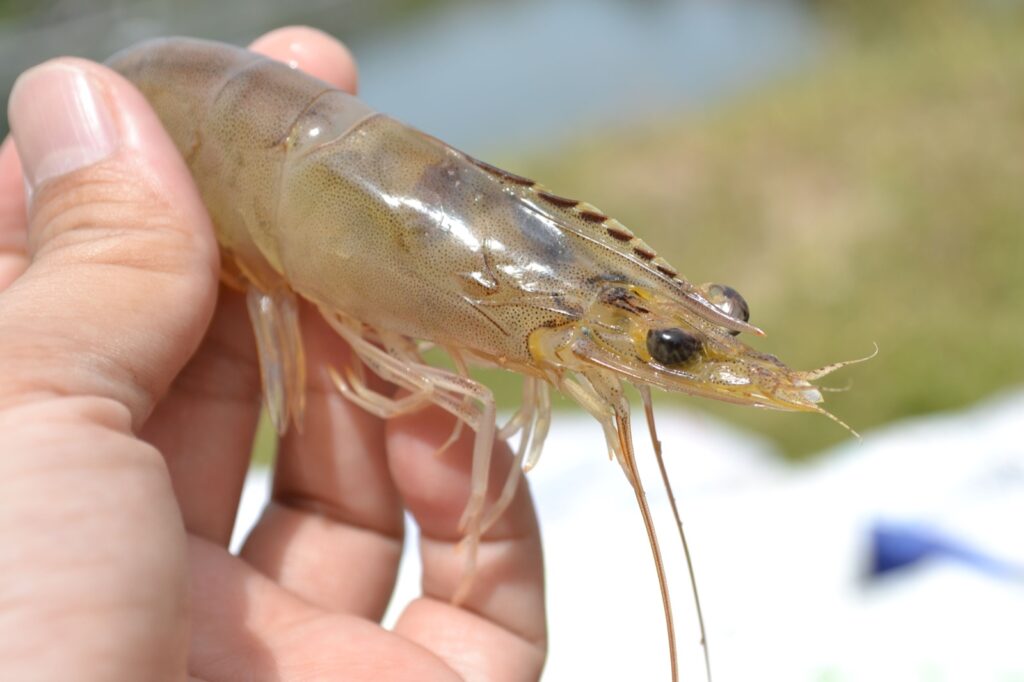
If you’ve bought shrimp at a US grocery store or ordered it at a restaurant in the last decade, there’s a very good chance it was vannamei — even if the menu or the label never used that word. It’s the shrimp behind most of what’s on ice at the seafood counter, and most people who eat it regularly have never actually heard its name.
What “vannamei” actually refers to
Vannamei — full scientific name Litopenaeus vannamei, also written Penaeus vannamei under older taxonomy — is more commonly known as whiteleg shrimp or Pacific white shrimp. It’s a warm-water species native to the eastern Pacific coast of the Americas, from Mexico down through Ecuador and Peru. “White shrimp” refers to its natural pale, translucent shell color, not to any processing or bleaching — it’s simply what the species looks like raw.
Why it dominates global shrimp farming
Vannamei isn’t just popular — it’s overwhelming the market. Multiple industry sources put it at somewhere between 75% and roughly 90% of total global farmed shrimp production, depending on the year and how “farmed shrimp” is measured. Its closest competitor, black tiger shrimp (Penaeus monodon), trails a distant second.
The reasons come down to farming economics, not flavor:
- Fast growth cycle — vannamei reaches market size in roughly 100 to 120 days, letting farmers run multiple harvests per year from the same ponds.
- Tolerance for a wide range of conditions — it handles a broad salinity range and adapts to different pond systems, which is part of why it’s now farmed in more than 40 countries.
- Lower feed cost — it needs a lower dietary protein percentage than species like black tiger shrimp, which matters directly to farming margins.
- Less aggressive behavior — it tolerates higher stocking densities without as much cannibalism-driven loss as some alternative species.
Black tiger shrimp is generally considered to have more pronounced flavor and a more visually striking shell color — but it’s harder and more expensive to farm at scale, which is exactly why vannamei took over the market instead.
Where it’s actually farmed
China is the largest single producer by volume. But the species’ native range tells a different story about where it started: vannamei isn’t Asian at all — it’s native to the Americas, specifically the Pacific coastal waters running from Mexico down through Ecuador to Peru. Ecuador and India have both expanded production significantly in recent years, and Ecuador in particular has built its entire shrimp export industry around a species that, biologically, has been in its coastal waters far longer than in any Asian farm.
Not all vannamei is farmed the same way
This is where the story usually stops in most “what is vannamei shrimp” explainers — but it shouldn’t, because how it’s farmed varies enormously by country, and that variation shows up directly in product quality and consistency. Intensive systems in parts of Asia stock as many as 300 shrimp per square meter in tightly managed tanks. Ecuador’s dominant model runs at a small fraction of that density, in large ponds designed to mimic natural estuarine conditions. We’ve written separately about why that distinction matters for buyers — it affects disease risk, antibiotic use, and how consistent a shipment is likely to be.
There’s also a quality issue every vannamei buyer eventually runs into regardless of origin: black spot (melanosis), a natural enzymatic reaction that has nothing to do with the species itself but everything to do with post-harvest handling.
Sourcing vannamei from its native waters
KATUNA Trade sources Litopenaeus vannamei directly from producers across Ecuador’s five coastal shrimp-farming provinces — a species farmed here not as an imported industry practice, but in the waters it’s biologically native to. If you’re evaluating vannamei suppliers and want to understand the difference between origins, explore our full shrimp sourcing guide or request samples directly.